 Add to Chrome
 Add to Firefox
 Add to Edge
OmniMatBench: A Human-Calibrated Multimodal Reasoning Benchmark Across 19 Materials Science Subfields
May 28, 2026
As multimodal language models play an increasingly important role in scientific research, materials science offers a critical testbed due to its interdisciplinary, multimodal, and application-driven nature. However, existing materials benchmarks mainly focus on property prediction, knowledge QA, or characterization understanding, leaving the broader reasoning process from materials knowledge to application underexplored. To fill this gap, we present OmniMatBench, a human-calibrated multimodal reasoning benchmark for materials science. OmniMatBench contains 3,171 expert-curated QA and calculation problems across 19 materials-science subfields, spanning fundamental materials knowledge, structural and engineering materials, materials processing and manufacturing, and functional and applied materials. We evaluate 13 open-source and closed-source MLLMs and find that the best model achieves only a 0.372 overall score, revealing a substantial gap in current materials-science reasoning. Further analysis shows strong variation across subfields, fixed reasoning heuristics, uneven materials knowledge, and limited high-level knowledge application under formula-, retrieval-, and code-assisted settings. OmniMatBench provides crucial insights into the capabilities and limitations of current MLLMs and establishes a foundation for reliable AI assistants in materials-science research.

Compute Allocation in Evolutionary Search: From Depth-Breadth to Multi-Armed Bandits
May 28, 2026LLM-guided evolutionary search (Evolve systems) has reached state-of-the-art results on mathematical and combinatorial tasks, yet most existing systems report only the best of many runs and leave the run-to-run distribution undocumented. We ask how a fixed budget of LLM calls should be allocated, and how reliably a single run reaches the reported numbers. Sweeping the depth-breadth grid over five models and three tasks, we identify two empirical regularities: a fitness-compute envelope along which capability ordering largely collapses on effective FLOPs, and a bilinear depth-breadth fit with task-specific interaction; both are gated by model-task capability. Motivated by these regularities, we propose BaSE (Bandit-based Self-Evolving), a multi-armed bandit that allocates LLM calls across parallel trajectories. Without changing the model, prompt, or evaluator, BaSE improves mean fitness by 12.3% over the strongest island-protocol baseline across 8 (model, task) cells, with the largest gains on high-variance settings: a reliability gain from allocation alone.
Dexora: Open-source VLA for High-DoF Bimanual Dexterity
May 18, 2026Vision-Language-Action (VLA) models have recently become a central direction in embodied AI, but current systems are restricted to either dual-gripper control or single-arm dexterous hand manipulation. While low-dimensional gripper control can often be handled with simpler methods, high-dimensional dexterous hand control benefits greatly from full end-to-end VLA learning. In this work, we introduce Dexora, the first open-source VLA system that natively targets dual-arm, dual-hand high-DoF manipulation. We design a hybrid teleoperation pipeline that decouples gross arm kinematics (captured with a custom exoskeleton backpack) from fine finger motion (markerless hand tracking via Apple Vision Pro), and that drives both a physical dual-arm dual-hand platform and an identical MuJoCo digital twin. Using that interface, we assemble a large training corpus: an embodiment-matched synthetic corpus (100K simulated trajectories, 6.5M frames) and a real-world dataset of 10K teleoperated episodes (2.92M frames). To mitigate noisy teleoperation demonstrations, we propose a data-quality-aware training recipe: an offline discriminator provides clip-level weights for diffusion-transformer policy training, down-weighting low-quality demonstrations. Empirically, Dexora outperforms competitive VLA baselines on both basic and dexterous benchmarks (e.g., average dexterous success 66.7% vs. 51.7%), attains 90% success on basic tasks, and shows robust out-of-distribution and cross-embodiment generalization. Ablations confirm the importance of real data and the discriminator for dexterity.
Efficient Camera Pose Augmentation for View Generalization in Robotic Policy Learning
Mar 31, 2026Prevailing 2D-centric visuomotor policies exhibit a pronounced deficiency in novel view generalization, as their reliance on static observations hinders consistent action mapping across unseen views. In response, we introduce GenSplat, a feed-forward 3D Gaussian Splatting framework that facilitates view-generalized policy learning through novel view rendering. GenSplat employs a permutation-equivariant architecture to reconstruct high-fidelity 3D scenes from sparse, uncalibrated inputs in a single forward pass. To ensure structural integrity, we design a 3D-prior distillation strategy that regularizes the 3DGS optimization, preventing the geometric collapse typical of purely photometric supervision. By rendering diverse synthetic views from these stable 3D representations, we systematically augment the observational manifold during training. This augmentation forces the policy to ground its decisions in underlying 3D structures, thereby ensuring robust execution under severe spatial perturbations where baselines severely degrade.
NMRTrans: Structure Elucidation from Experimental NMR Spectra via Set Transformers
Feb 10, 2026Nuclear Magnetic Resonance (NMR) spectroscopy is fundamental for molecular structure elucidation, yet interpreting spectra at scale remains time-consuming and highly expertise-dependent. While recent spectrum-as-language modeling and retrieval-based methods have shown promise, they rely heavily on large corpora of computed spectra and exhibit notable performance drops when applied to experimental measurements. To address these issues, we build NMRSpec, a large-scale corpus of experimental $^1$H and $^{13}$C spectra mined from chemical literature, and propose NMRTrans, which models spectra as unordered peak sets and aligns the model's inductive bias with the physical nature of NMR. To our best knowledge, NMRTrans is the first NMR Transformer trained solely on large-scale experimental spectra and achieves state-of-the-art performance on experimental benchmarks, improving Top-10 Accuracy over the strongest baseline by +17.82 points (61.15% vs. 43.33%), and underscoring the importance of experimental data and structure-aware architectures for reliable NMR structure elucidation.
Index-ASR Technical Report
Dec 31, 2025Automatic speech recognition (ASR) has witnessed remarkable progress in recent years, largely driven by the emergence of LLM-based ASR paradigm. Despite their strong performance on a variety of open-source benchmarks, existing LLM-based ASR systems still suffer from two critical limitations. First, they are prone to hallucination errors, often generating excessively long and repetitive outputs that are not well grounded in the acoustic input. Second, they provide limited support for flexible and fine-grained contextual customization. To address these challenges, we propose Index-ASR, a large-scale LLM-based ASR system designed to simultaneously enhance robustness and support customizable hotword recognition. The core idea of Index-ASR lies in the integration of LLM and large-scale training data enriched with background noise and contextual information. Experimental results show that our Index-ASR achieves strong performance on both open-source benchmarks and in-house test sets, highlighting its robustness and practicality for real-world ASR applications.
MolAct: An Agentic RL Framework for Molecular Editing and Property Optimization
Dec 24, 2025Molecular editing and optimization are multi-step problems that require iteratively improving properties while keeping molecules chemically valid and structurally similar. We frame both tasks as sequential, tool-guided decisions and introduce MolAct, an agentic reinforcement learning framework that employs a two-stage training paradigm: first building editing capability, then optimizing properties while reusing the learned editing behaviors. To the best of our knowledge, this is the first work to formalize molecular design as an Agentic Reinforcement Learning problem, where an LLM agent learns to interleave reasoning, tool-use, and molecular optimization. The framework enables agents to interact in multiple turns, invoking chemical tools for validity checking, property assessment, and similarity control, and leverages their feedback to refine subsequent edits. We instantiate the MolAct framework to train two model families: MolEditAgent for molecular editing tasks and MolOptAgent for molecular optimization tasks. In molecular editing, MolEditAgent-7B delivers 100, 95, and 98 valid add, delete, and substitute edits, outperforming strong closed "thinking" baselines such as DeepSeek-R1; MolEditAgent-3B approaches the performance of much larger open "thinking" models like Qwen3-32B-think. In molecular optimization, MolOptAgent-7B (trained on MolEditAgent-7B) surpasses the best closed "thinking" baseline (e.g., Claude 3.7) on LogP and remains competitive on solubility, while maintaining balanced performance across other objectives. These results highlight that treating molecular design as a multi-step, tool-augmented process is key to reliable and interpretable improvements.
TA-VLA: Elucidating the Design Space of Torque-aware Vision-Language-Action Models
Sep 09, 2025Many robotic manipulation tasks require sensing and responding to force signals such as torque to assess whether the task has been successfully completed and to enable closed-loop control. However, current Vision-Language-Action (VLA) models lack the ability to integrate such subtle physical feedback. In this work, we explore Torque-aware VLA models, aiming to bridge this gap by systematically studying the design space for incorporating torque signals into existing VLA architectures. We identify and evaluate several strategies, leading to three key findings. First, introducing torque adapters into the decoder consistently outperforms inserting them into the encoder.Third, inspired by joint prediction and planning paradigms in autonomous driving, we propose predicting torque as an auxiliary output, which further improves performance. This strategy encourages the model to build a physically grounded internal representation of interaction dynamics. Extensive quantitative and qualitative experiments across contact-rich manipulation benchmarks validate our findings.
Reasoning BO: Enhancing Bayesian Optimization with Long-Context Reasoning Power of LLMs
May 19, 2025Many real-world scientific and industrial applications require the optimization of expensive black-box functions. Bayesian Optimization (BO) provides an effective framework for such problems. However, traditional BO methods are prone to get trapped in local optima and often lack interpretable insights. To address this issue, this paper designs Reasoning BO, a novel framework that leverages reasoning models to guide the sampling process in BO while incorporating multi-agent systems and knowledge graphs for online knowledge accumulation. By integrating the reasoning and contextual understanding capabilities of Large Language Models (LLMs), we can provide strong guidance to enhance the BO process. As the optimization progresses, Reasoning BO provides real-time sampling recommendations along with critical insights grounded in plausible scientific theories, aiding in the discovery of superior solutions within the search space. We systematically evaluate our approach across 10 diverse tasks encompassing synthetic mathematical functions and complex real-world applications. The framework demonstrates its capability to progressively refine sampling strategies through real-time insights and hypothesis evolution, effectively identifying higher-performing regions of the search space for focused exploration. This process highlights the powerful reasoning and context-learning abilities of LLMs in optimization scenarios. For example, in the Direct Arylation task, our method increased the yield to 60.7%, whereas traditional BO achieved only a 25.2% yield. Furthermore, our investigation reveals that smaller LLMs, when fine-tuned through reinforcement learning, can attain comparable performance to their larger counterparts. This enhanced reasoning capability paves the way for more efficient automated scientific experimentation while maintaining computational feasibility.
Dynamic Legged Ball Manipulation on Rugged Terrains with Hierarchical Reinforcement Learning
Apr 21, 2025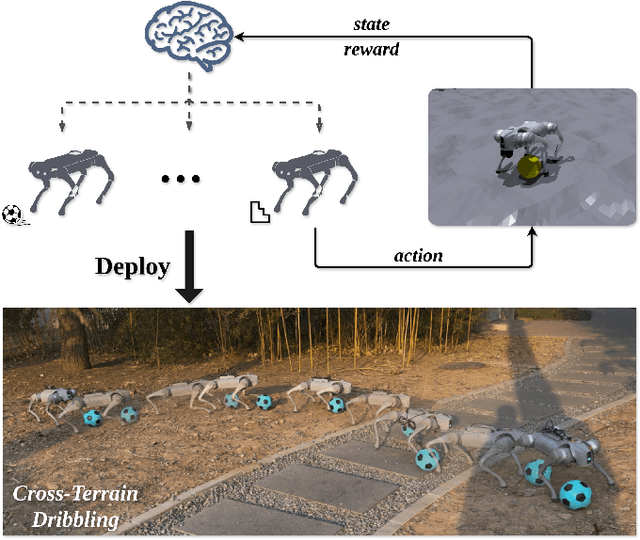
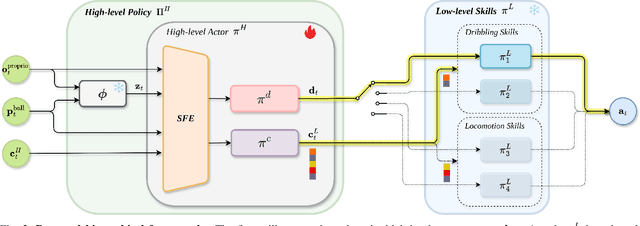
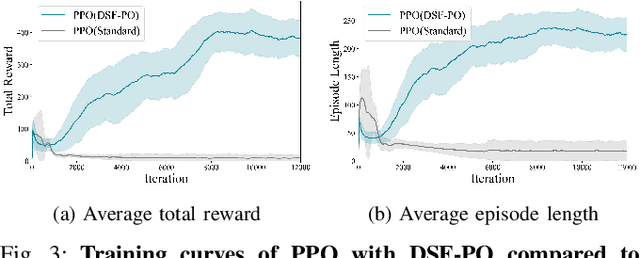
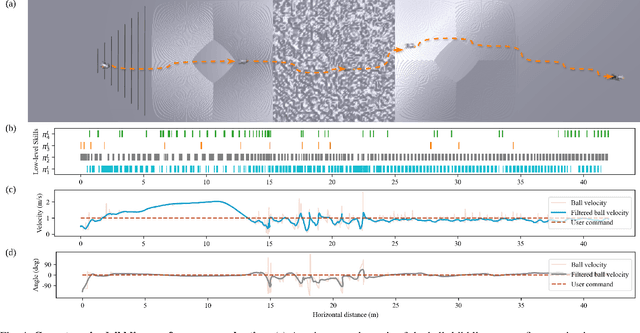
Advancing the dynamic loco-manipulation capabilities of quadruped robots in complex terrains is crucial for performing diverse tasks. Specifically, dynamic ball manipulation in rugged environments presents two key challenges. The first is coordinating distinct motion modalities to integrate terrain traversal and ball control seamlessly. The second is overcoming sparse rewards in end-to-end deep reinforcement learning, which impedes efficient policy convergence. To address these challenges, we propose a hierarchical reinforcement learning framework. A high-level policy, informed by proprioceptive data and ball position, adaptively switches between pre-trained low-level skills such as ball dribbling and rough terrain navigation. We further propose Dynamic Skill-Focused Policy Optimization to suppress gradients from inactive skills and enhance critical skill learning. Both simulation and real-world experiments validate that our methods outperform baseline approaches in dynamic ball manipulation across rugged terrains, highlighting its effectiveness in challenging environments. Videos are on our website: dribble-hrl.github.io.